The Triple Tax: How Tariffs, a Weak Loonie, and Bank Exchange Fees Erode Canadian Purchasing Power
By Aaron C. Zhang, Senior Forex Market Analyst

If you have booked a trip to the United States, bought products online from an American merchant, or simply walked through a Canadian supermarket produce aisle recently, you have likely noticed that prices are rising fast. While official inflation metrics remain relatively subdued, cross-border commerce is being squeezed by three compounding costs: import tariffs, a depreciated Canadian dollar, and aggressive retail banking fees.
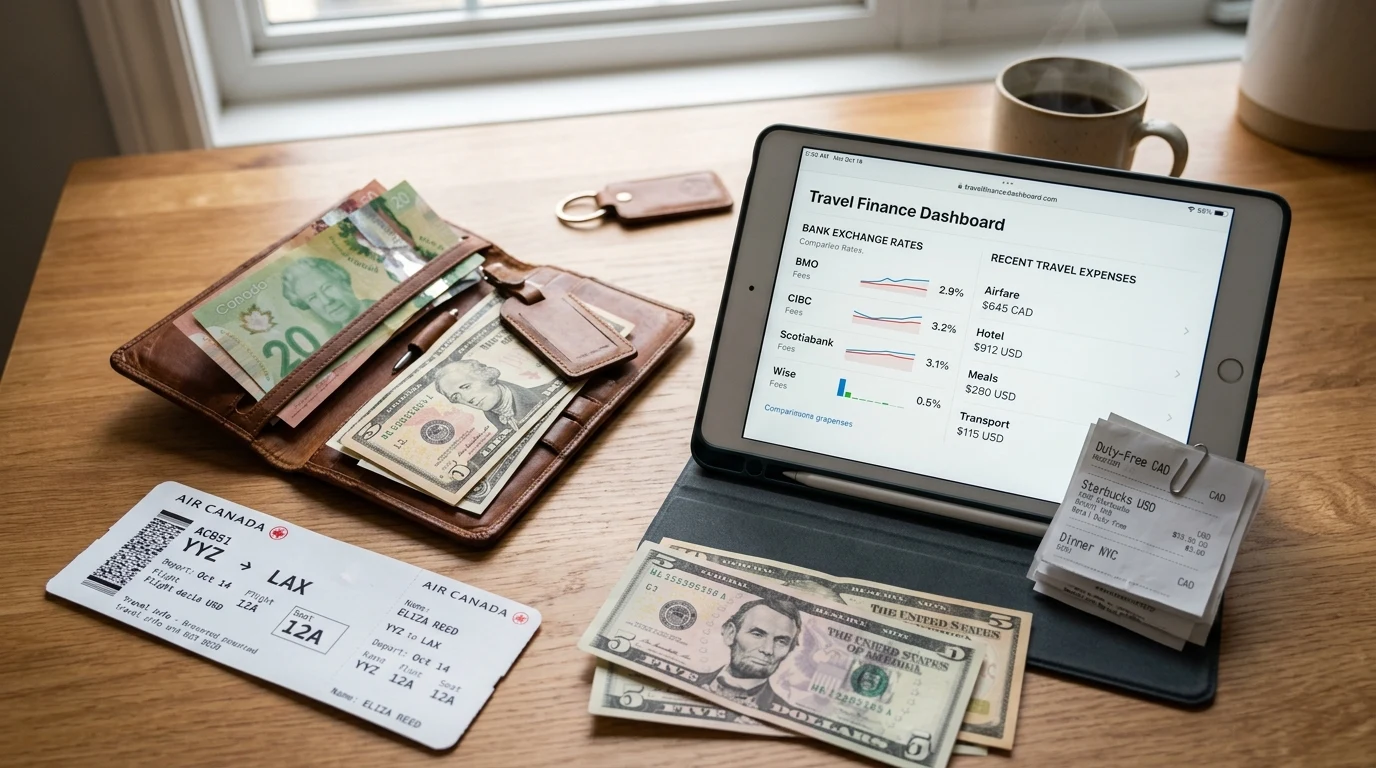
Understanding the triple cost structure
When trade tensions escalate between trading partners, financial discussions often focus on corporate supply chains and government trade balances. For Canadian households, however, the financial consequences land directly on personal checking accounts and credit card statements. These costs arrive in three consecutive waves:
| Cost Layer | Primary Driver | Typical Rate or Impact | Who Pays It |
|---|---|---|---|
| Layer 1: Tariff Surcharge | US tariffs and Canadian counter-tariffs | 10% to 50% border surcharges | Importers, passed to retail consumers |
| Layer 2: Currency Depreciation | Loonie weakening to 1.41 USD/CAD | 1.41 CAD per 1.00 USD baseline | Anyone purchasing US-denominated goods |
| Layer 3: Bank FX Markup | Big 5 bank retail teller spreads & card fees | 2.5% to 4.0% hidden conversion margin | Bank customers exchanging cash or swiping cards |
Layer 1: The tariff tax on everyday imports
Canada relies on the United States for an extensive catalog of consumer products. According to Statistics Canada, Canada imports over $35 billion in agricultural products and packaged foods annually, the majority sourced from California, Florida, and the American Midwest.
When bilateral trade talks break down and reciprocal tariffs take effect, wholesale import distributors face immediate border duties. An importer bringing in packaged goods or seasonal fruits must pay border surcharges upon entry. Because wholesale margins in food distribution are notoriously thin (typically 2 to 4 percent), businesses cannot absorb these tariffs internally. They pass them directly to grocery chains, which pass them to shoppers at checkout.
Layer 2: The currency depreciation discount
Even if an imported product is exempt from explicit border tariffs, it cannot escape the foreign exchange market. Most international contracts are denominated in US dollars. When the Canadian dollar softens from 1.35 to 1.41 against the greenback, every dollar of imported goods automatically costs six cents more in Canadian terms.
Consider an American item priced at $100 USD wholesale. In early 2024, when the exchange rate sat near 1.34, the Canadian importer paid $134 CAD. At today's 1.41 exchange rate, that exact same product costs $141 CAD, an immediate 5.2 percent price hike before shipping, handling, or store markups are added.
Layer 3: The hidden retail banking markup
The third layer is where consumers face the largest avoidable expense: retail banking fees. When individual Canadians purchase US goods, travel south for winter vacation, or pay international tuition, they rarely get the interbank rate shown on financial news websites.
Canada's major chartered banks routinely apply an exchange rate spread of 2.5 to 3.5 percent on retail currency conversions. In our detailed investigation into the true cost of converting CAD to USD at Canadian banks, we showed how an institution advertising "no commission" simply widens the buy/sell spread to capture profit.
Furthermore, if you swipe a standard Canadian credit card while shopping in the US or ordering online, your card issuer adds a mandatory 2.5 percent foreign transaction fee on top of an already padded exchange rate. A purchase that was nominally $100 USD ends up costing upwards of $146 CAD once the bank processes the transaction.
The math on a winter vacation budget ($5,000 USD)
Suppose a Canadian family budgets $5,000 USD for a two-week winter vacation in California or Florida:
- At true interbank rate (1.410): $5,000 USD costs $7,050 CAD.
- At Big 5 bank teller rate (1.460, 3.5% spread): That same $5,000 USD costs $7,300 CAD.
- Via standard credit card swipes (1.41 + 2.5% card fee + 1% network margin = 1.460): You pay $7,300 CAD.
- Total hidden banking cost: $250 CAD lost to transaction spreads alone, without purchasing a single extra meal or hotel night.
Actionable ways Canadians can protect their money
While individuals cannot alter international trade treaties or set central bank policy rates, you can completely eliminate the third layer of costs:
1. Compare wholesale exchange rates before visiting a branch
Never accept the teller's first quoted rate without verifying the market benchmark. You can check real-time exchange rates on our Live Rate Board and review live bank spreads on our Bank Comparison Rates Page.
2. Use physical cash for cross-border day-to-day spending
Carrying physical US dollars eliminates the 2.5 percent foreign transaction fee charged by major credit card issuers. Currency Mart provides zero-fee cash conversions on amounts over $300 CAD, allowing you to lock in favorable rates before you depart.
3. Pick up currency at dedicated local branches
Traditional bank branches frequently require several business days to order physical banknotes, especially in higher denominations. Currency Mart maintains confirmed stock of US dollars and over 50 global travel currencies across physical branches in Toronto Downtown (PATH), Toronto North York, Winnipeg Downtown, and Winnipeg St. Vital.
Frequently asked questions
Further reading on Canadian foreign exchange
- The Loonie as a Shock Absorber: How US-Canada Trade Talks Dictate the Canadian Dollar
- USD/CAD Pushes Past 1.41: Could Trade Tensions Drive the Canadian Dollar Toward 1.45?
- Why Oil Isn't Saving the Loonie: How Trade Tariffs and Rate Gaps Broke Canada's Petro-Currency Link
- The True Cost of Converting CAD to USD: Big 5 Canadian Banks vs. Currency Mart
- How to Get the Best Currency Exchange Rates in Canada
Stay in the know
Get live rate alerts and timely currency updates directly in your inbox.