USD/CAD Pushes Past 1.41: Could Trade Tensions Drive the Canadian Dollar Toward 1.45?
By Aaron C. Zhang, Senior Forex Market Analyst

The USD/CAD currency pair has cleared the 1.41 handle, trading at levels not seen since the acute market stresses of earlier downturns. With bilateral trade negotiations under strain and retaliatory tariffs now active, foreign exchange desks in Toronto and New York are asking whether the loonie is headed for 1.45, an exchange rate that would translate to less than 69 cents US per Canadian dollar.
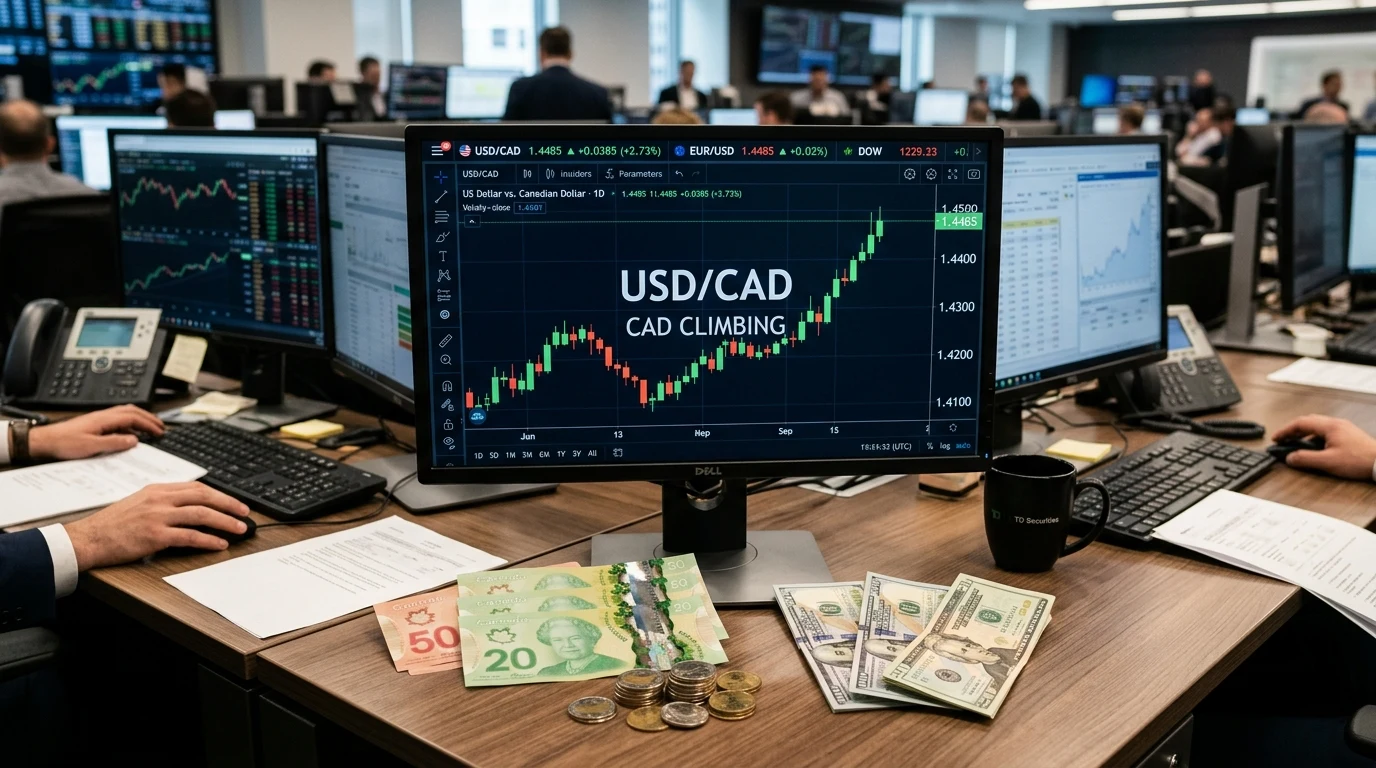
Breaking through the 1.41 technical barrier
For several quarters, foreign exchange analysts viewed 1.39 to 1.40 as a reliable resistance ceiling for the US dollar against the Canadian dollar. Whenever the greenback approached 1.40, Canadian energy export receipts and institutional rebalancing pulled the pair back toward 1.36.
That ceiling broke in September 2026. The breakdown in bilateral trade talks and the decision by the United States to decline a long-term CUSMA renewal prompted global macro funds to reassess Canada's growth trajectory. Technical indicators confirm the shift: 50-day and 200-day moving averages have turned upward, signaling that institutional investors are treating 1.40 as support rather than resistance.
Historical precedent: what happened in 2016 and 2020?
Levels above 1.40 are uncommon in modern Canadian financial history. Over the past twenty years, USD/CAD has traded above 1.42 during only two distinct episodes:
| Historical Episode | Peak USD/CAD Rate | CAD Low (in USD) | Primary Catalyst |
|---|---|---|---|
| January 2016 | 1.458 | $0.685 USD | WTI crude collapse to $27 per barrel |
| March 2020 | 1.465 | $0.682 USD | Global pandemic liquidity freeze, flight to USD cash |
| September 2026 (Current) | 1.412 | $0.708 USD | Trade dispute, 50% tariffs, CUSMA renewal deadlock |
In both 2016 and 2020, reaching 1.45 required an acute global crisis. The question for 2026 is whether a simmering trade war and annual treaty reviews carry enough economic weight to replicate those conditions.
Three catalysts that could trigger a run to 1.45
Financial analysts at major Canadian institutions, including RBC, TD, and BMO, have outlined three specific scenarios where USD/CAD could advance another 400 pips to test 1.45:
1. Expansion of US tariffs to energy or automotive sectors
Current 50 percent tariffs apply to approximately $20 billion in targeted manufacturing products. If negotiations deteriorate further and border measures expand to integrated automotive assemblies in Ontario or cross-border pipeline flows, Canadian terms of trade would deteriorate sharply. Because automotive trade alone accounts for tens of billions in bilateral activity, any tariff on finished vehicles would trigger an immediate sell-off in the loonie.
2. Bank of Canada policy divergence
The Bank of Canada held its policy interest rate at 2.25 percent in September, acknowledging that tariff friction acts as a headwind against consumer spending. If domestic unemployment rises while the US economy remains firm, Governor Tiff Macklem and the Governing Council could decide to lower rates to 2.00 or 1.75 percent to stimulate domestic borrowing. If the US Federal Reserve keeps its benchmark rate above 3.50 percent, the widening rate gap would accelerate capital flight toward higher-yielding US dollar assets.
3. Institutional divestment and capital chills
Foreign direct investment relies on legal predictability. Under the previous six-year CUSMA review model, global corporations planned multi-year capital budgets with confidence that North American borders would remain open. Under the new framework of mandatory annual joint reviews, businesses face recurring headline risk. If multinational corporations decide to redirect manufacturing investments from Canadian industrial corridors to US locations, the structural demand for Canadian dollars will decline over an extended timeframe.
What a 1.45 exchange rate means for your finances
A move from 1.41 to 1.45 may sound like a minor fluctuation, but in percentage and dollar terms, it represents a substantial shift in purchasing power:
| US Dollar Amount | Cost at 1.35 CAD | Cost at 1.41 CAD (Current) | Cost at 1.45 CAD (Projected Peak) | Total Difference |
|---|---|---|---|---|
| $1,000 USD (Traveler) | $1,350 CAD | $1,410 CAD | $1,450 CAD | +$100 CAD |
| $10,000 USD (Snowbird / Tuition) | $13,500 CAD | $14,100 CAD | $14,500 CAD | +$1,000 CAD |
| $100,000 USD (Commercial Importer) | $135,000 CAD | $141,000 CAD | $145,000 CAD | +$10,000 CAD |
When you layer standard bank retail markups on top of these figures, the effective cost rises even further. At 1.45 wholesale, a commercial bank charging 3.5 percent spreads will quote you an effective exchange rate near 1.50.
Practical defensive strategies for individuals and businesses
Rather than attempting to forecast the exact peak of currency movements, Canadians with US dollar commitments can take practical defensive measures:
- Track the true spread on every transaction: Check live interbank quotes on our Live Rate Board and compare bank markups on our Bank Comparison Rates Page before agreeing to teller rates.
- Stage conversions through dollar-cost averaging: If you must convert large sums for winter stays or equipment purchases, execute transactions in thirds or quarters over several weeks. This protects you against converting an entire balance on a temporary volatility spike.
- Eliminate transaction fees: Retail exchanges over $300 CAD at Currency Mart carry zero service fees, ensuring every dollar converted goes toward your foreign funds.
- Secure physical cash in advance: With trade headlines generating sudden spikes, local cash supplies can tighten. Currency Mart branches in Toronto Downtown (PATH), Toronto North York, Winnipeg Downtown, and Winnipeg St. Vital maintain physical US cash inventory for immediate pickup.
Frequently asked questions
Further reading on Canadian foreign exchange
- The Loonie as a Shock Absorber: How US-Canada Trade Talks Dictate the Canadian Dollar
- Canada's 2026 Economic Outlook: Interest Rates, Housing, and CAD Projections
- The Oil-Shock Comeback: Why the Loonie Defied Gravity During Global Energy Surges
- The True Cost of Converting CAD to USD: Big 5 Canadian Banks vs. Currency Mart
- Norbert's Gambit vs. Currency Exchange Services: Speed, Costs, and Execution Compared
Stay in the know
Get live rate alerts and timely currency updates directly in your inbox.