The Loonie as a Shock Absorber: How US-Canada Trade Talks Dictate the Canadian Dollar
By Aaron C. Zhang, Senior Forex Market Analyst

Whenever trade negotiations between Ottawa and Washington turn contentious, the reaction appears first on foreign exchange trading screens. The Canadian dollar softens, the USD/CAD exchange rate climbs toward 1.40 or 1.41, and headlines question whether the currency is in trouble. Economists at the Bank of Canada describe this dynamic differently: the loonie functions as the primary shock absorber for the national economy.
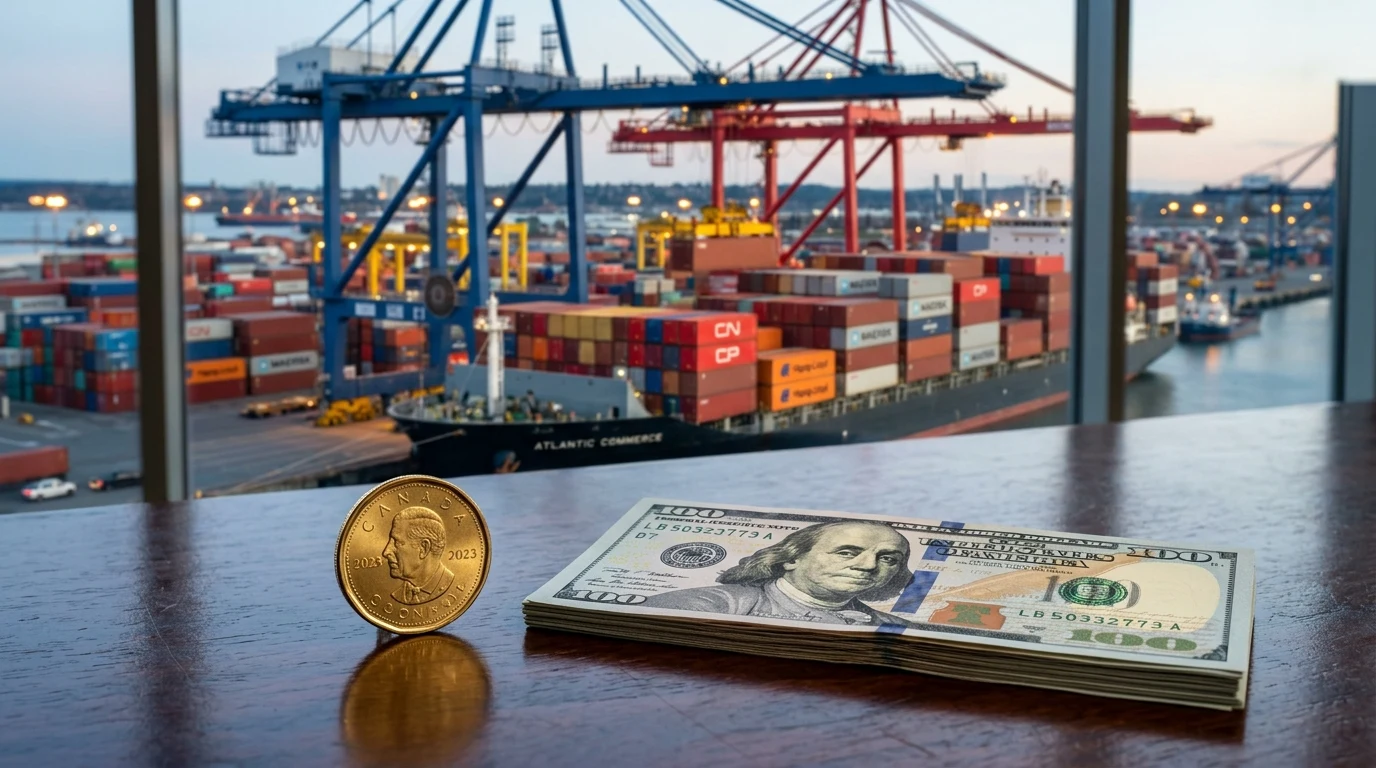
How the shock absorber mechanism works
According to Statistics Canada, more than three-quarters of all Canadian merchandise exports cross the southern border into the United States. Automotive parts, steel, softwood lumber, agriculture, and energy depend heavily on open access to American buyers.
When trade negotiations stall or tariffs enter the picture, the immediate consequence is a drop in anticipated demand for Canadian goods. In a fixed exchange rate system, domestic producers would have to absorb the entire blow through immediate wage cuts, price drops, or plant closures. In Canada's flexible exchange rate regime, the currency bears the initial impact.
As international capital re-evaluates Canadian growth prospects, institutional traders sell the Canadian dollar and buy the US dollar. That depreciation reduces the price of Canadian exports when converted back into American greenbacks. A Canadian-made auto component or lumber shipment that faces a 10 percent border surcharge becomes less punitive for an American importer if the Canadian dollar has softened by four or five cents over the same period. The falling currency cushions the blow for domestic exporters, even as it raises import costs at home.
The 2026 CUSMA joint review and recurring negotiations
The current pressure on the loonie traces back to the joint review of the Canada-United States-Mexico Agreement (CUSMA). The treaty, which took effect in 2020, included a formal six-year review clause set for July 1, 2026. The mandate was straightforward: all three countries were asked whether they wanted to extend the agreement for an additional 16-year term.
While Canada and Mexico favored a long-term extension, the Office of the United States Trade Representative declined to renew the agreement for the full 16-year block. The treaty has not expired; its original terms protect trade until 2036. The refusal to sign a 16-year extension activated a specific procedural clause: the three countries must now participate in mandatory annual joint reviews.
This procedural shift replaced a predictable multi-year trade pact with a cycle of continuous negotiations. Corporate treasurers and foreign investors dislike policy ambiguity. When capital allocators face uncertainty about future cross-border rules, they pause factory expansions and shift capital into US-dollar-denominated assets. That steady outflow maintains constant upward pressure on the USD/CAD exchange rate.
| CUSMA Status | Previous Structure (2020–2026) | Current Framework (Post-July 2026) | Impact on USD/CAD |
|---|---|---|---|
| Review Frequency | Every 6 years | Mandatory annual joint reviews | Creates continuous baseline risk premium |
| Tariff Friction | Tariff-free trade across core sectors | Sectoral disputes (dairy, lumber, steel, EVs) | Reduces Canadian export volume expectations |
| Corporate Investment | Long-term capital expenditure plans | Deferred capital spending, risk mitigation | Weakens capital account flows into CAD |
| Loonie Function | Reflected cyclical commodity prices | Acts as primary shock absorber for trade risk | Elevates USD/CAD toward 1.40–1.41 range |
Reciprocal tariffs and the breakdown in talks
The tension expanded beyond procedural disagreements when the United States introduced 50 percent tariffs targeting approximately $20 billion worth of Canadian industrial goods. Friction points included longstanding disputes over supply-managed dairy quotas, Canadian digital services taxation, and concerns over whether Chinese manufacturing could enter the United States through Canadian supply chains.
In response, Ottawa announced dollar-for-dollar counter-tariffs on select American imports, which took effect in September 2026. While retaliatory measures defend domestic policy sovereignty, trade barriers between integrated economies reduce overall economic output on both sides of the border.
Because Canada's economy is roughly one-tenth the size of the US economy, cross-border friction has an asymmetric impact. The United States accounts for roughly three-quarters of Canadian exports, while Canada takes about 17 percent of US exports. Foreign exchange markets reflect that asymmetry immediately: whenever trade disputes heat up, the loonie drops faster and further than the greenback.
Why high oil prices are not lifting the loonie
Historically, the Canadian dollar moved in tandem with crude oil. When West Texas Intermediate (WTI) and Western Canadian Select (WCS) rallied, foreign buyers converted currency into Canadian dollars to pay for oil shipments, driving the loonie upward. In earlier market cycles, crude trading near $90 or $100 per barrel pushed the loonie toward 80 cents US (around 1.25 USD/CAD).
In 2026, that traditional link has separated. Even with elevated energy prices, two opposing forces hold the loonie down:
- Trade dispute discount: Tariff threats against Canadian manufacturing and agriculture offset gains generated by energy exports. Investors discount the broader economy even when energy balance sheets look healthy.
- Interest rate yield gap: The Bank of Canada held its overnight policy rate at 2.25 percent during its September meeting, citing trade uncertainty and cooling consumer demand. Meanwhile, the US Federal Reserve maintained a higher benchmark rate, creating an interest rate gap of roughly 150 basis points. Global investment capital flows toward higher yields in US Treasury bonds.
Our previous analysis on why the loonie defied gravity during earlier oil shocks showed how petro-revenues can temporarily mask domestic weakness. As trade talks stalled, that petro-windfall lost its ability to counter the drag from US tariffs.
The triple cost for Canadian consumers
When the Canadian dollar acts as an economic shock absorber, the relief it gives to exporters shifts real costs onto Canadian consumers. The combination of tariffs, a softer currency, and retail banking markups creates three distinct expenses:
- Import price inflation: Canada imports fresh produce, medical supplies, electronics, and consumer vehicles priced in US dollars. At a 1.41 exchange rate, every dollar of imported goods costs $1.41 CAD before shipping, retail markup, or local taxes.
- Tariff pass-through: Retaliatory tariffs placed on US consumer products show up directly on retail store shelves, increasing prices for everyday items.
- Hidden bank exchange spreads: When Canadians convert funds for winter travel, business inventory, or online purchases, major Canadian financial institutions routinely add a 2.5 to 4.0 percent markup on top of the wholesale exchange rate.
The real-dollar impact on a $10,000 exchange
Converting $10,000 CAD to USD at an interbank rate of 1.41 yields roughly $7,092 USD. At a typical Big 5 bank charging a 3.5 percent retail markup (effective rate around 1.46), that same $10,000 CAD yields only $6,849 USD. The traveler or business loses $243 USD (over $340 CAD) on a single transaction.
Strategies to manage currency volatility
Cross-border businesses, online shoppers, and travelers heading south can take practical steps to reduce currency drag while trade talks proceed:
1. Monitor wholesale benchmarks instead of retail teller boards
Before executing any conversion, check the true mid-market rate. You can track real-time rates on our Live Rate Board and compare live spreads on our Bank Comparison Rates Page. Knowing the wholesale benchmark reveals exactly how much a financial institution is charging you in hidden spreads.
2. Avoid standard credit card foreign transaction fees
Most Canadian credit cards charge a mandatory 2.5 percent foreign transaction fee on top of an unfavorable conversion rate. When traveling to the United States, carrying physical US cash or using dedicated foreign currency accounts prevents credit card processors from taking a cut on every coffee or hotel bill.
3. Convert in planned blocks rather than ad hoc transactions
If you have ongoing US dollar requirements for tuition, business inventory, or winter stays in Florida or Arizona, avoid converting small amounts every few weeks. Every small retail exchange triggers minimum fees or wider spreads. Converting in scheduled blocks of $300 CAD or more at Currency Mart eliminates service fees entirely.
4. Use local cash branches with confirmed inventory
Many traditional bank branches keep limited foreign cash on hand, requiring two to three business days of notice for US currency withdrawals. Currency Mart branches in Toronto Downtown (PATH), Toronto North York, Winnipeg Downtown, and Winnipeg St. Vital carry physical banknotes in stock with immediate fulfillment.
Frequently asked questions
Further reading on Canadian foreign exchange
- Canada's 2026 Economic Outlook: Interest Rates, Housing, and CAD Projections
- The Oil-Shock Comeback: Why the Loonie Defied Gravity During Global Energy Surges
- The True Cost of Converting CAD to USD: Big 5 Canadian Banks vs. Currency Mart
- Norbert's Gambit vs. Currency Exchange Services: Speed, Costs, and Execution Compared
- How to Get the Best Currency Exchange Rates in Canada
Stay in the know
Get live rate alerts and timely currency updates directly in your inbox.